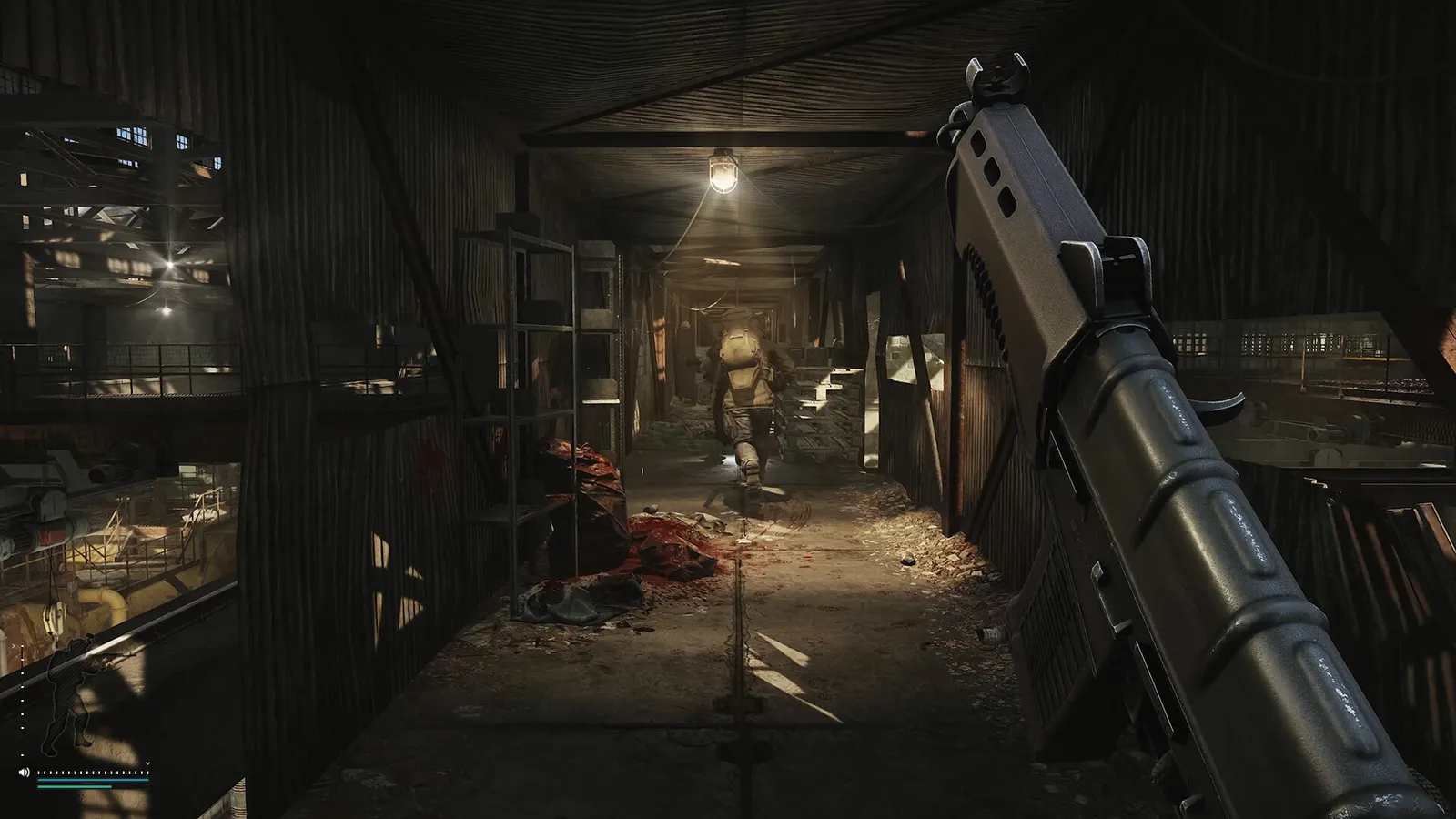
Checked against the official wiki and patch notes up to patch 1.3.0.1 (November 2026). Update 1.3.5.0, the move to Unity 6, is announced for mid-November and may shift values again, so treat in-game screens as the final word.
Your character has seven body parts, each with its own HP pool: head, thorax, stomach, two arms and two legs. If the head or thorax reaches zero you die at once, and surgery cannot bring either back. Every other problem, from bleeding to broken legs, has its own fix, so the habit to build is: stop the bleed first, fix the fracture second, take painkillers when you need to fight, and heal HP last.
Body parts and damage
Damage to one part does not simply drain the whole bar. A destroyed arm or leg spreads incoming damage to the rest of your body at a reduced rate, and a destroyed stomach multiplies hydration and energy drain by five. A destroyed part stays dead until you restore it with a surgical kit or leave the raid. Health carries over between raids, so you must heal in the Health tab afterwards.
Status effects and what to do
| Problem | Effect | Fix |
|---|---|---|
| Light bleed | Removes about 1.36 HP from each working part every 6 seconds | Bandage |
| Heavy bleed | About 1.53 HP every 4 seconds and leaves a blood trail | Tourniquet or hemostatic item |
| Fracture (leg) | Speed cut by about 45 percent, no sprinting without painkillers | Splint |
| Fracture (arm) | Slower aiming, searching and reloading | Splint |
| Pain | Tremors after about 45 seconds untreated | Painkillers |
| Poison | About 140 HP per minute | Antidote or special injector only |
| Dehydration | Starts about 50 seconds after hydration reaches zero, then 1 HP every 15 seconds per part | Drink |
| Exhaustion | Starts about 30 seconds after energy reaches zero, then 1 HP every 5 seconds per part | Eat |
A treated heavy bleed becomes a fresh wound that lasts about 480 seconds and can open again, so do not sprint around right after treating it. Painkillers hide the effects of pain and fractures for a while but heal nothing.
Surgery for destroyed parts
CMS and Surv12 surgical kits restore a destroyed body part to 1 HP. The CMS leaves it at about 25 to 45 percent of its maximum HP for the rest of the raid and the Surv12 at about 60 to 72 percent. Either way you need more healing afterwards or the part is destroyed again at the next hit. The Surgery skill speeds this up.
Raid medical kit for beginners
- One painkiller, hotkeyed.
- One bandage for light bleeds.
- One item that stops heavy bleeds.
- One splint.
- A larger healing item such as a Salewa for budget raids.
- Food and water for longer maps.
Put the items on hotkeys before the raid. Looking through your backpack in the middle of a fight is how most beginners die.
What to do when you are hit
- Get behind cover. Healing in the open invites a second shot.
- Treat a heavy bleed before anything else, then a light bleed.
- Splint a broken leg if you need to move quickly, or take a painkiller to sprint again.
- Top up HP only after the dangerous effects are gone.
- If a limb is destroyed and the raid is going well, consider a surgical kit; otherwise extract carefully.
Recovering between raids
You regenerate passively at about 456.6 HP per hour, plus 1 energy and 1 hydration per minute. The Hideout speeds this up: the Medstation and Rest Space help health, the Nutrition Unit and Heating help energy and the Water Collector helps hydration. Therapist offers paid treatment, and it is free for accounts below level 11 with 30 or fewer raids, so use it early.
What dying costs you
A normal death sets your health to 30 percent. Deaths from suicide, exhaustion, teammates, disconnects, mines, claymores, border snipers or not having a firearm set every part to 1 percent. After death you keep only your armband, melee weapon, secure container and special slots.
Skills worth knowing
- Health: improves metabolism; trains indirectly from other physical skills.
- Vitality: trains by taking damage and bleeding.
- Surgery: trains by using surgical kits.
- Stress Resistance: unlocks a Berserk effect at low health.
Frequently asked questions
Can I fix a blacked-out limb mid-raid?
Only with a surgical kit. Otherwise it stays dead until you leave.
Is armour or health more important?
They cover different problems. Armour stops damage, healing items save a raid after the damage happens.
Quick tips
- Stop bleeds first.
- Hotkey your meds.
- Use Therapist's free treatment while you are new.
- Read the insurance guide in this series and see the game page.