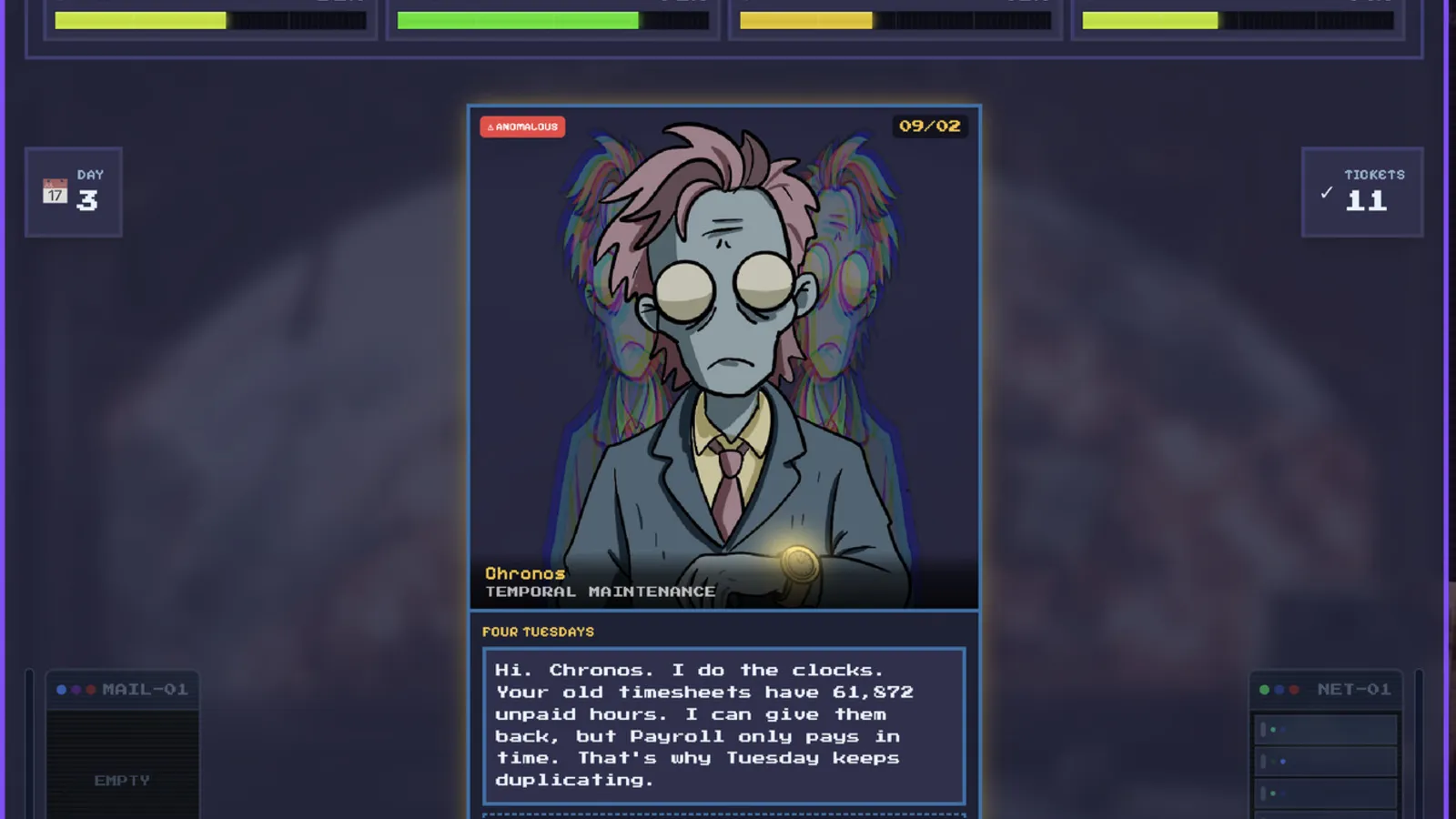
In I.T. Never Ends you work IT support for a company run by cosmic horrors: each ticket is a card that you approve (swipe right) or deny (swipe left), and your choices move four meters: Productivity, Budget, Morale and Entropy. If any of them hits zero your shift ends, and if Entropy climbs too high the building starts to react. The whole game is learning which answer costs what, and a bad run is part of the design.
How do tickets and swipes work?
Every day brings a stream of tickets from coworkers. Each has two answers, and both have consequences: approving a request can help morale but cost budget, denying it may protect the budget but upset somebody. Characters remember what you did, and conversations change on later days and in later runs. The game ships with more than 60 colleagues, so read the card and who sent it, not just the request.
What do the four metrics mean?
| Meter | What it measures | Warning |
|---|---|---|
| Productivity | How much work the company gets done | Zero ends the shift |
| Budget | The company's money | Zero ends the shift |
| Morale | How happy the staff are | Zero ends the shift |
| Entropy | How strange and unstable the office is | Climbing entropy has its own consequences; zero ends the shift like the others, per the store page |
The developer has rebalanced entropy across tickets and boosters since launch, so old advice may not match the current version.
What are the manual override minigames?
Some work cannot be done by swiping. The game uses short tactile minigames that start as recognisable IT tasks and then get stranger:
- Redacting forbidden text: censor a document before anyone reads what should not be read.
- Stabilising the network: patch packet loss and route traffic before the server room floods.
- Hunting rogue data: track data through the servers before it corrupts something.
- Other jobs: routing cables, filtering spam, repairing hardware, onboarding new colleagues and performance reviews.
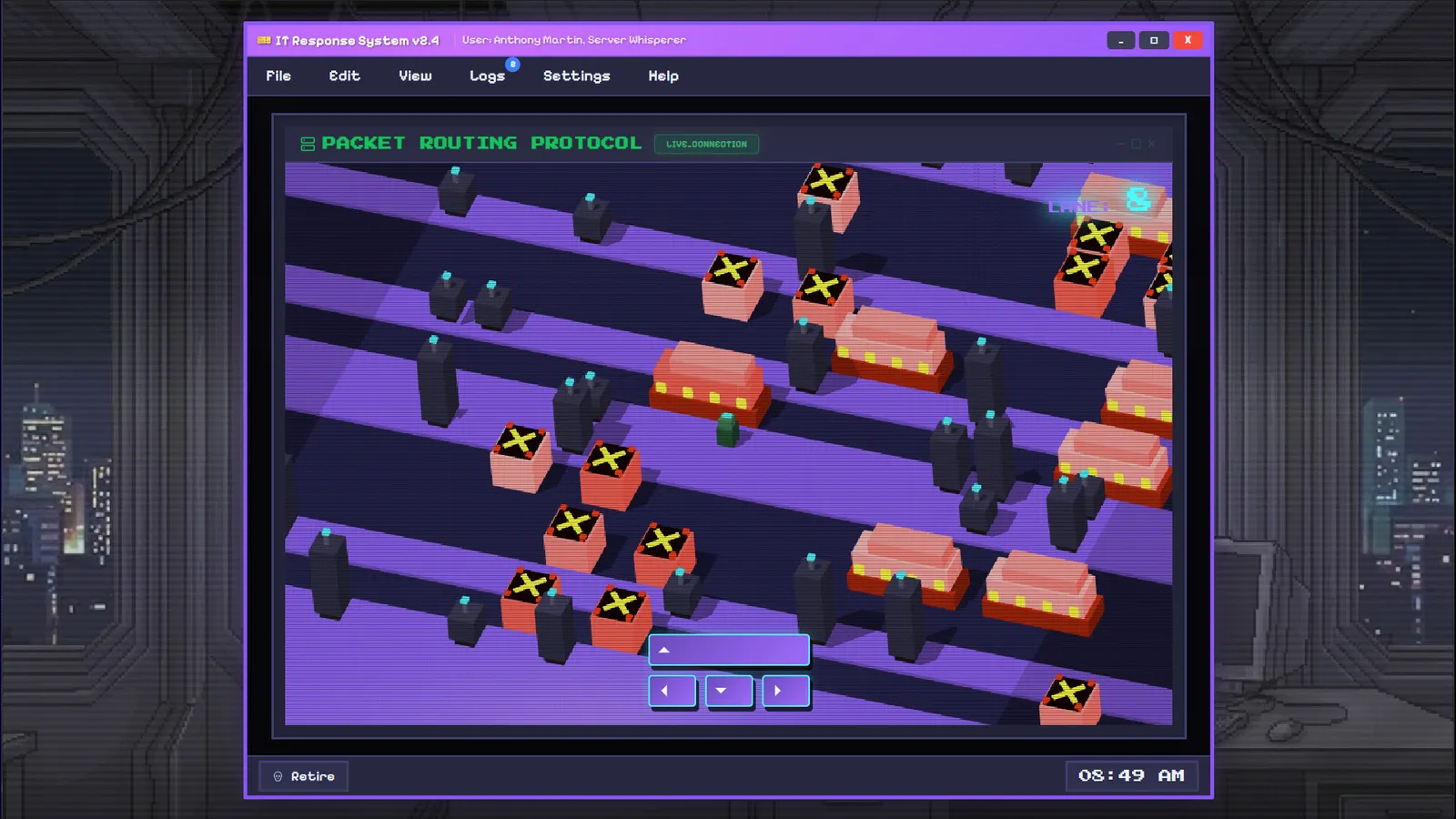
One of the network minigames in the game.
How do I avoid an early game over?
- Do not chase one meter at the cost of the others; watch all four after each swipe.
- Do not approve or deny everything on autopilot; both answers have consequences.
- Learn the recurring characters. They remember what you did.
- Take the minigames seriously; they are part of the work.
- Expect to lose. Each run reveals new tickets and makes the next shift easier.
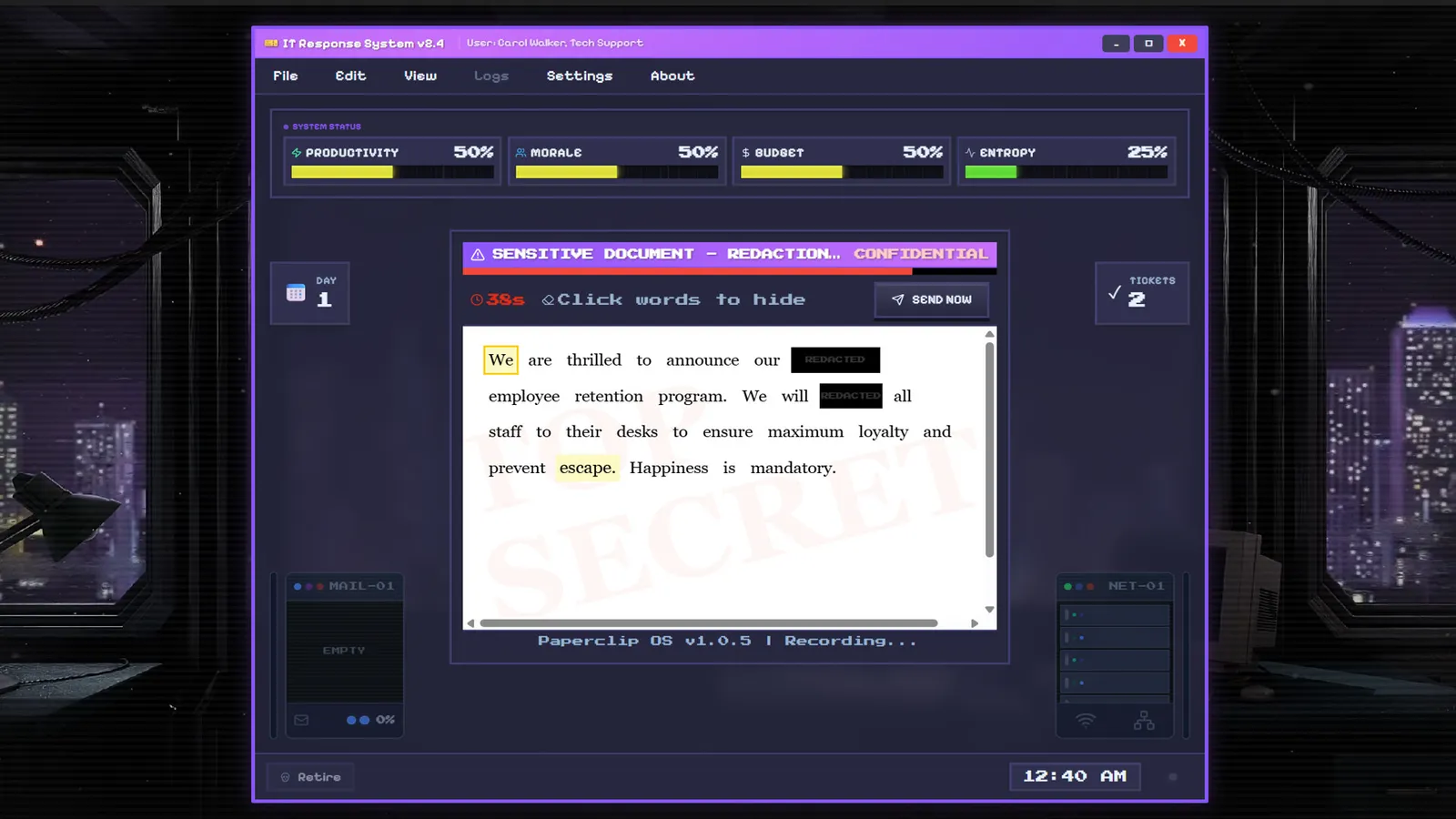
Redaction minigame: click the words that must not be read.
What else do the minigames show on screen?
The network minigames run their own meters, such as Packet Loss and the Inbox meter, and the developer tuned them after launch: in an early patch the Packet Loss meter was made to rise more like the Inbox meter, which makes decisions harder. Do not assume advice from the first week still applies; the developer also rebalanced entropy across tickets and boosters in the September content update.
What does a run look like?
- You start a shift and get a stream of tickets; each has two answers.
- Between tickets, optional minigames or special events (onboarding, performance reviews, rogue data) appear.
- When a meter reaches zero the shift ends. The run becomes a story beat that unlocks new tickets and choices for the next one.
- Later "veteran" runs bring extra arcs and push the endings you still lack.
The developer reported players with more than 45 runs reaching the endgame in the first three days after launch, so do not feel that early losses are a problem.
How much does it cost and what do I get?
It launched on Steam on 14 August 2026 at 12.99 US dollars with a 10 percent launch discount (the store showed about 13.49 euro in November 2026). The developer describes more than 100,000 written words, more than 60 colleagues and entities, and more than 100 endings at launch (120 now).
Do performance reviews matter?
Yes. They were in the game from launch but easy to miss, and a patch in October 2026 makes them appear when they are due. If you answer them, the HR drone files a memo on your next shift: recognition, a follow-up form or a Performance Improvement Plan.
Is it playable on my PC and Mac?
The requirements are small: an i3-class CPU, 4 GB of RAM and a GTX 460 or better, 500 MB of disk space. Apple silicon Macs are supported since September 2026, and Steam Cloud syncs your save. If a 3D minigame crashes, turn on hardware acceleration; the game warns on the main menu when it is off. See our system requirements page.
FAQ
Is I.T. Never Ends a roguelike?
It plays like one: each shift is a run, the run ends when a meter hits zero, and what carries over is what the characters remember about you.
Can I play it on Mac?
Yes, on Apple silicon since the September 2026 content update.
Does it have a demo?
There was a demo in 2026 and a browser prototype before it; check the store page for the current state.
Quick tips
- Use the Reading Speed option in the settings if the outcome text goes too fast.
- Do not chase endings in your first runs; see the endings guide when you are ready.
- Take a break; the tickets are written to keep you on one more shift.