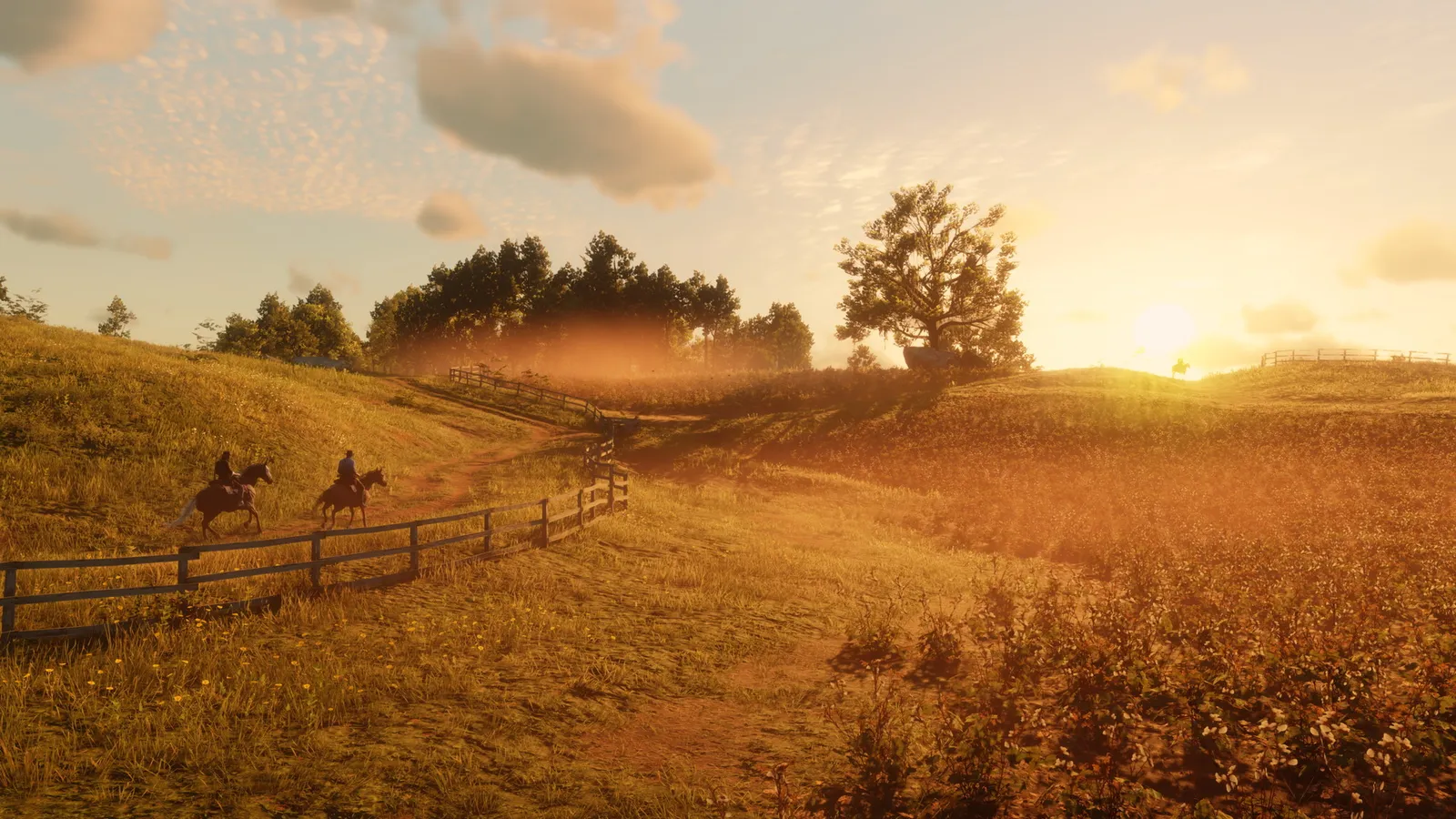
Rockstar's Wild West open-world game. It is one of the most GPU-hungry games around at Ultra, but a handful of settings (volumetrics, reflections, water, shadows) cost most of the frames, so tuning them gets a big gain for a small loss in looks.
What limits performance in Red Dead Redemption 2
Red Dead Redemption 2 runs on RAGE (Open-world action-adventure, 2019 (PC)). Official and researched system requirements:
- Minimum: OS Windows 10 64-bit; CPU Intel Core i5-2500K or AMD FX-6300; RAM 8 GB; GPU NVIDIA GeForce GTX 770 2 GB or AMD Radeon R9 280 3 GB; Storage 150 GB
- Recommended: OS Windows 10 64-bit; CPU Intel Core i7-4770K or AMD Ryzen 5 1500X; RAM 12 GB; GPU NVIDIA GeForce GTX 1060 6 GB or AMD Radeon RX 480 4 GB; Storage 150 GB
The settings that cost the most frames
Menu names and sections below are the ones in the game. Start here, test after each change, and keep the ones that give a clear gain.
- Graphics API (Settings > Graphics > Advanced): Vulkan (try DirectX 12 if it is unstable). Needs a restart. Guides disagree on which API is faster, so test both on your own card and keep the steadier one.
- Resolution (Settings > Graphics): native resolution, or lower for more frames. Use your monitor's native resolution and scale with DLSS or FSR instead.
- Lighting Quality (Settings > Graphics): Low on the Low preset up to Ultra on Ultra. Ultra is rarely worth the cost over High, especially at night.
- Global Illumination Quality (Settings > Graphics): Low on the Low preset up to Ultra on Ultra. Bounced light and ambient shading; lower it first if you see CPU-side stutter.
- Shadow Quality (Settings > Graphics): Low on the Low preset up to Ultra on Ultra. Medium or High is enough; lower distant shadows before nearby ones.
- SSAO (Settings > Graphics): Low on the Low preset up to High on Ultra. Screen-space ambient occlusion; Medium keeps most of the depth. Full Resolution SSAO adds more cost and is best left off at 1080p.
- Reflection Quality (Settings > Graphics): Low on the Low preset up to High on Ultra. One of the two settings that cost the most; Medium looks close to High in play.
- Volumetric Lighting Quality (Settings > Graphics > Advanced): Low on the Low preset up to High on Ultra. Fog, god rays and clouds of light. Together with reflections this is where most frames are won back; lower the far volumetric setting first in bad weather.
- Water Quality (Settings > Graphics > Advanced): Low on the Low preset up to High on Ultra. Medium is usually enough; Water Physics Quality is a separate slider that should stay at or below half.
- Tree Quality (Settings > Graphics > Advanced): Low on the Low preset up to Ultra on Ultra. Also loads the CPU in forests; lower it first if you are CPU-bound.
- MSAA (Settings > Graphics): Off. Very costly for little gain over TAA; keep it off, and leave FXAA off when TAA is on.
Smaller options
| Setting | Where | Recommended |
|---|---|---|
| Texture Quality | Settings > Graphics | Low on the Low preset up to Ultra on Ultra |
| Anisotropic Filtering | Settings > Graphics | x4 on the Low preset up to x16 on Ultra |
| Far Shadow Quality | Settings > Graphics | Low on the Low preset up to Ultra on Ultra |
| TAA | Settings > Graphics | Medium on the Low preset up to High on Ultra |
| Motion Blur | Settings > Graphics | Off |
Upscaling and frame generation
Upscalers: DLSS, FSR. No frame generation is listed. No Reflex or Anti-Lag 2 option is listed.
- DLSS / FSR (Settings > Graphics). Options: Off, NVIDIA DLSS, AMD FSR 2.0. The biggest single FPS gain at 1440p and 4K. Enabling DLSS disables TAA, MSAA and Resolution Scale.
How to show the FPS counter
- Steam: open Steam > Settings > In Game and set "In-game FPS counter" to a screen corner.
- Other options are the NVIDIA App overlay or MSI Afterburner / RivaTuner.
- Test changes in the same spot and the same time of day, one setting family at a time.
Launch options for Red Dead Redemption 2
-ignorepipelinecache: Community fix for stutter and crashes after updates; set in the Rockstar Games Launcher. Results are mixed.
More Red Dead Redemption 2 tips
Unlock the advanced graphics options
- In Settings > Graphics, enable "Unlock Advanced Graphics for Installed GPU".
- This reveals the Advanced Settings section with volumetrics, water, tree and geometry options.
Vulkan or DirectX 12
- Switch the Graphics API in Settings > Graphics > Advanced Settings. The game must restart to apply it.
- Results vary per GPU and driver: compare average and 1% low FPS in the same save and keep the steadier one.
- FSR 2.0 works in both DirectX 12 and Vulkan.
Stutter after a driver or game update
- Add -ignorepipelinecache in the Rockstar Games Launcher: Settings > Red Dead Redemption 2 > Launch arguments.
- It is a community fix with mixed results, not an official recommendation. Remove it again if it does not help.
When the CPU is the limit
- Lower Tree Quality, Geometry Level of Detail and Global Illumination Quality first: they load the CPU, not the GPU.
- Enable XMP or EXPO so your RAM runs at its rated speed.
Quick checks that help in any game
Before you spend an hour in the menus, rule out the common system-level causes of low FPS and stutter in Red Dead Redemption 2:
- Update your graphics driver and restart. Game-ready drivers often include fixes for new releases.
- Set the Windows power plan to Balanced or High performance, and turn on Game Mode.
- Enable the XMP or EXPO memory profile in your BIOS. Many PCs run RAM below its rated speed, which costs frames in CPU-limited games.
- Install the game on an SSD, not a hard drive, to avoid hitching when assets stream in.
- Close browsers, launchers and overlays you do not need. Each one takes CPU time and memory.
- Watch your temperatures. A CPU or GPU that overheats lowers its clocks, and the result is lower, uneven frame rates.
- Match the frame cap to your monitor, or use adaptive sync so a steady frame rate does not tear.
How to test a change properly
Change one setting at a time and repeat the same short test, ideally in the same place or mode, while watching both the average and the lowest frame rates. The 1% lows tell you more about smoothness than the average does. If a setting changes the picture a lot but the frame rate barely moves, put it back; if it moves the frame rate a lot and the picture barely changes, keep it lower. Check whether the GPU or CPU is the one running at 95 to 100 percent: lowering resolution-related settings only helps when the GPU is the bottleneck, while lowering view distance, crowd and physics options is what helps when the CPU is.
Best settings for your hardware
Every PC is different, so the best choice depends on your CPU, graphics card and monitor. On DontLag you can find recommended settings for each hardware tier on the Red Dead Redemption 2 settings page.