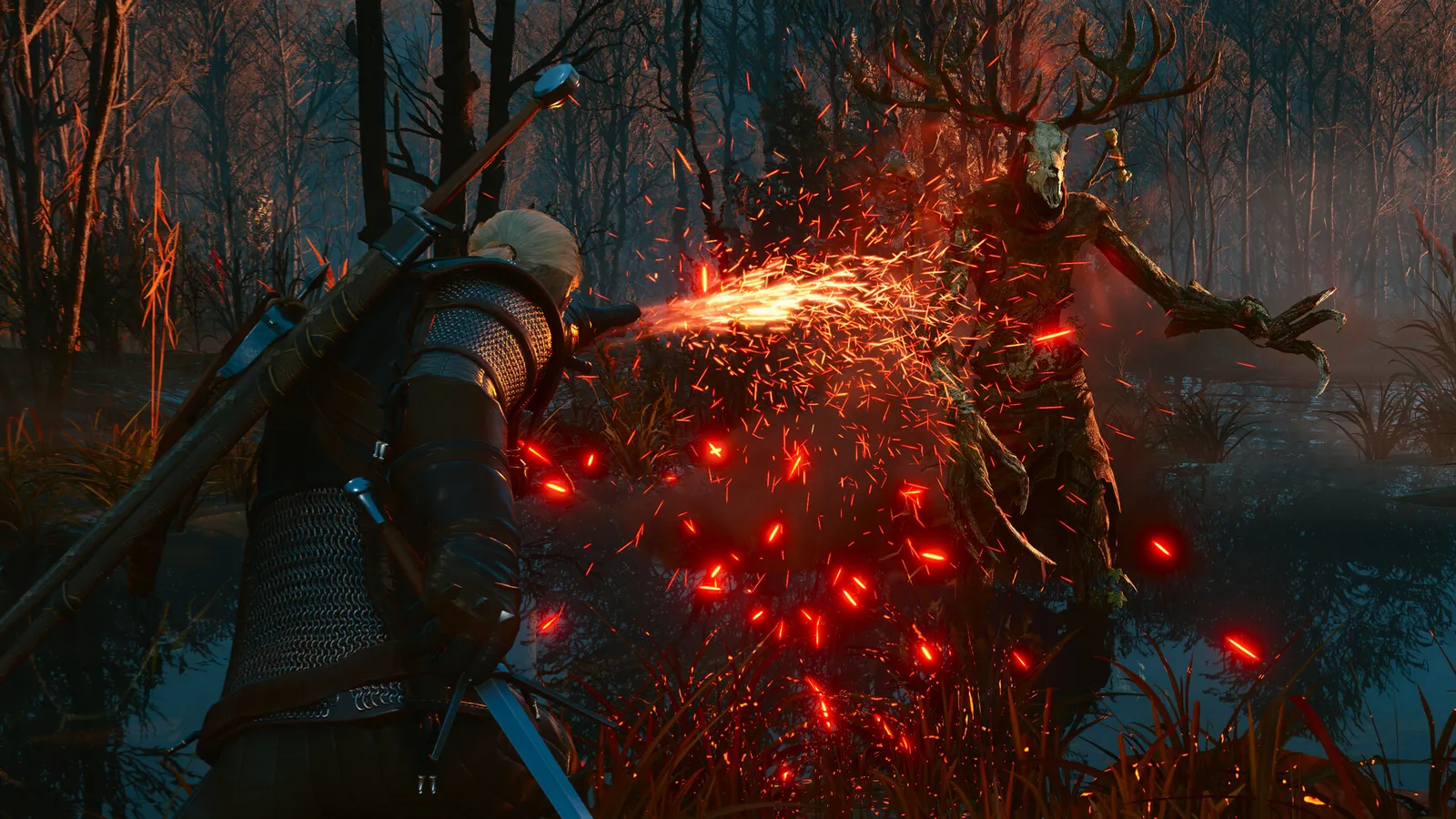
Witcher 3 alchemy comes down to three kinds of consumables. Oils are applied to your blade to deal extra damage to one monster class. Mutagens go into their own slots and boost a stat by colour: red for attack power, green for vitality and blue for Sign intensity. Decoctions are powerful single-charge buffs made from monster mutagens that add toxicity until they wear off. The Remastered (September 2026) rebuilt the Alchemy skill tree, so the numbers below follow the current skill list and the in-game tooltips are the final word.
How do blade oils work?
An oil adds a temporary damage bonus against one monster class. The bonus is multiplicative and counted after your other damage modifiers. Each oil has a number of charges, and every successful hit uses one, even a hit on a monster the oil does not target. A counter under the toxicity meter shows how many hits are left. Oils can be reapplied as often as you like, unlike potions and decoctions, which need meditation to refill. A blade normally carries one oil at a time, so applying a new one replaces the old one.
| Tier | Bonus against its monster class | Charges |
|---|---|---|
| Base | +10% attack power | 20 |
| Enhanced | +25% attack power | 40 |
| Superior | +50% attack power | 60 |
Each tier needs the previous one as an ingredient. You make oils at the alchemy bench from a formula (manuscript pages), which turn up in chests, with merchants or as quest rewards. Hanged Man's Venom goes on the steel sword, and almost every other oil goes on the silver sword. Beast oil is the exception and works on both.

Beasts like bears are weak to Beast Oil.
Which oil for which monster?
| Monster class | Oil | Typical examples |
|---|---|---|
| Beasts | Beast Oil | Wolves, bears, dogs |
| Cursed Ones | Cursed Oil | Werewolves |
| Draconids | Draconid Oil | Wyverns, basilisks, cockatrices |
| Elementa | Elementa Oil | Golems, elementals |
| Humans and nonhumans | Hanged Man's Venom | Bandits, soldiers, elves, dwarves |
| Hybrids | Hybrid Oil | Griffins, harpies |
| Insectoids | Insectoid Oil | Endregas, arachas |
| Necrophages | Necrophage Oil | Drowners, ghouls |
| Ogroids | Ogroid Oil | Nekkers, trolls |
| Relicts | Relict Oil | Leshens, fiends, chorts |
| Specters | Specter Oil | Wraiths, noonwraiths |
| Vampires | Vampire Oil | Katakans, ekimmaras |
The bestiary entry for a monster tells you its class and the oil to use. The Remastered adds an option to auto-apply blade oils, and patch 5.01 (8 October 2026) fixed it so the setting stays on across sessions.
How do mutagens work?
Geralt has up to four mutagen slots, unlocked at levels 4, 9, 16 and 28. Each slot is linked to three ability slots. Every ability of the same colour next to a mutagen adds another 100% of that mutagen's effect, so three matching abilities quadruple it. Mismatched abilities are not penalised, they just add nothing.
- Red mutagens raise attack power and pair with Combat skills.
- Green mutagens raise vitality and pair with Alchemy skills.
- Blue mutagens raise Sign intensity and pair with Signs skills.
| Tier | Red | Green | Blue |
|---|---|---|---|
| Lesser | +5% attack power (max +20%) | +50 vitality (max +200) | +5% Sign intensity (max +20%) |
| Standard | +7% (max +28%) | +100 (max +400) | +7% (max +28%) |
| Greater | +10% (max +40%) | +150 (max +600) | +10% (max +40%) |
The "max" figures assume three matching abilities. In the base game only lesser mutagens drop, and you craft the higher tiers from them; Blood and Wine monsters can also drop standard and greater ones. Special mutagens from specific monsters (Troll, Katakan, Succubus and others) act as lesser mutagens and are the key ingredient for decoctions. The Synergy skill, which now lives in the General tree, raises all slotted mutagen bonuses by 10%, 20% or 30% at ranks 1 to 3.
How do decoctions work?
- Each decoction needs its own formula, a special mutagen from the matching monster and ingredients; Dwarven spirit appears in almost every recipe.
- Each decoction has one charge and lasts 1,800 seconds. The Basilisk decoction is the exception, lasting 5,760 seconds, but its effect only triggers at 6:00 in the morning or evening.
- Most decoctions add 50 toxicity (70 before the 4.0 next-gen update). The Basilisk decoction adds 40. This toxicity does not fade over time: it clears when the decoction ends or when you meditate or drink white honey.
- Meditating for at least an hour with strong alcohol in your inventory refills decoctions, potions and bombs. The game uses White Gull first, then alcohest, then Dwarven spirit.
Useful examples include the Katakan decoction (more critical hit chance), the Troll decoction (vitality regeneration), the Werewolf decoction (better stamina regeneration on moonlit nights) and the Cockatrice decoction (alchemy creations usable one extra time).
How does toxicity work?
Geralt's default maximum toxicity is 100. Above 50% (the overdose threshold) he loses 0.5% of his maximum health per second until toxicity drops below the threshold or you reduce it with white honey. Every potion adds toxicity, so a decoction at 50 points uses half of your capacity on its own. This is why the toxicity skills matter for alchemy builds.
Which Alchemy skills matter in the Remastered?
The rebuilt tree gives every skill three ranks, and each rank adds 2% potion duration and bomb damage on top of its own effect. These are the ones most relevant to this guide, with the prerequisite in brackets:
| Skill | Effect per rank |
|---|---|
| Adaptability (needs Refreshment) | Mutagen decoctions last 33%, 67% and 100% longer |
| Poisoned Blades (needs Efficiency, Frenzy or Endure Pain) | Oiled blades have a 5%, 10% or 15% chance to poison |
| Protective Coating (needs Pyrotechnics) | 5%, 10% or 15% protection against the monster type your oil targets |
| Acquired Tolerance (needs Hunter Instinct) | Maximum toxicity rises by 1, 2 or 3 for each learned alchemy recipe |
| Tissue Transmutation (needs Protective Coating, Acquired Tolerance or Toxic Shock) | Decoctions add 300, 600 or 900 maximum vitality while active |
| Fast Metabolism (needs Delayed Recovery or High Tolerance) | Toxicity falls 1, 2 or 3 points per second faster |
The tree also holds bomb skills (Pyrotechnics, Cluster Bombs, Volatile Compound) and potion skills such as Refreshment and Side Effects. Our Remastered skill tree guide shows how the tree fits with the others.
Where do the mutagens come from?
Lesser red mutagens drop from monsters such as the Doppler, Katakan, Succubus, Werewolf and Wyvern. Lesser green mutagens come from the Arachas, Ekimmara, Fiend, Griffin and Troll, among others. Lesser blue mutagens come from the Basilisk, Chort, Cockatrice, Leshen and Forktail, among others. Go after the matching monster when you need a specific colour.
Quick tips
- Check the bestiary before a fight and apply the matching oil.
- Keep one of each colour of lesser mutagen to craft the standard tier.
- Carry a bottle of alcohol, since refilling your potions at a meditation spot needs one.
- Take Acquired Tolerance when you want to run decoctions without hitting your toxicity limit.
- Our builds and armour guides show the gear that supports an alchemy build.