
Rocket League runs on a handful of fixed numbers. Small boost pads give 12 boost and big pads give 100, supersonic speed starts at 2200 units per second, and every car belongs to one of six hitbox classes. Knowing them helps you plan your boost and pick a car whose shape you like. These values come from published game data and community research, and can change with patches. Written for Season 24 (patch 2.78 era, October 2026).
Boost pads
| Pad | Boost given | Respawn |
|---|---|---|
| Small | 12 | about 4 seconds |
| Big | 100 | 10 seconds |
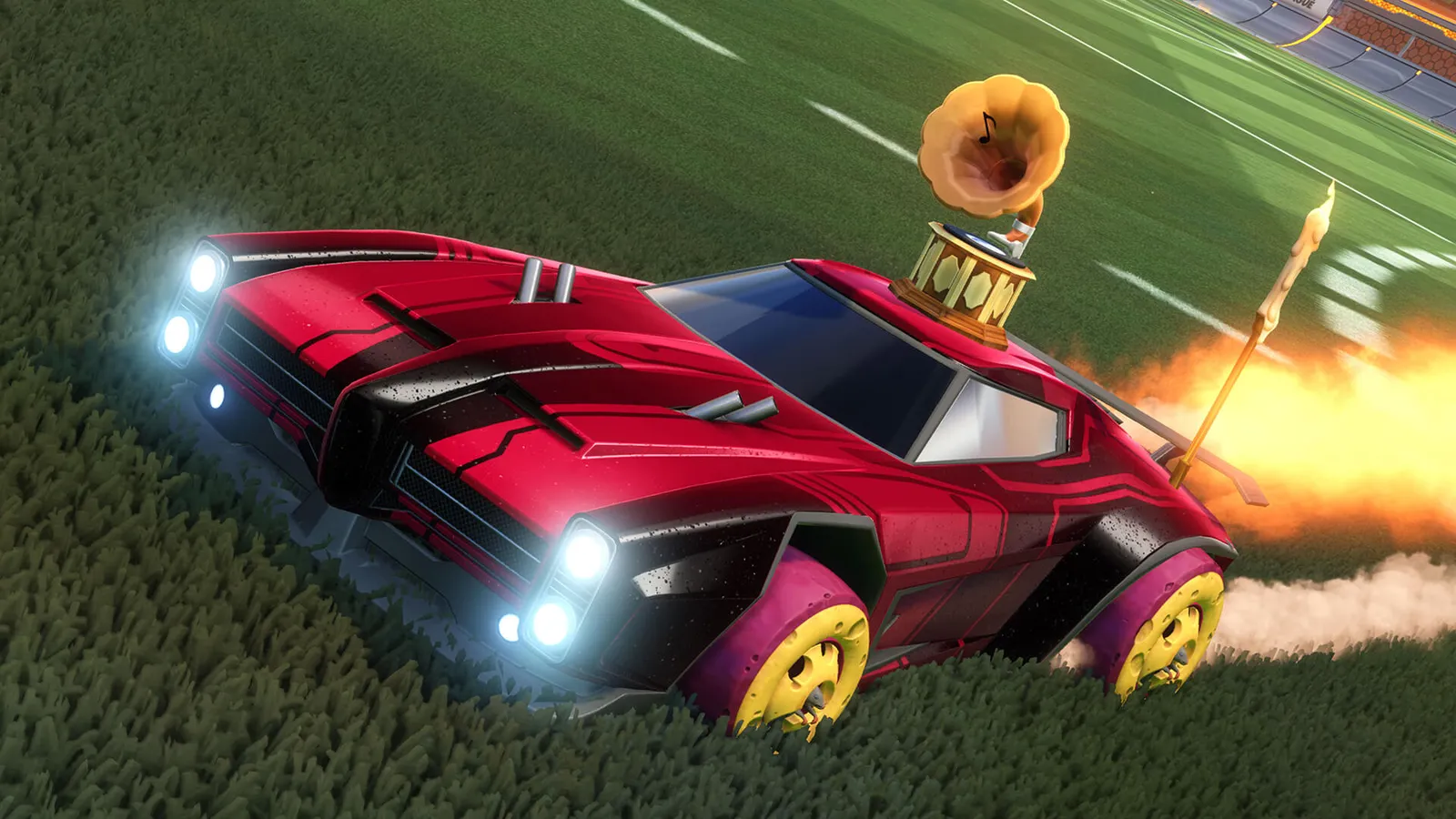
Boost is what leaves the flame trail behind the car.
One fan guide gives about 5 seconds for small pads, while the game data gives 4.0, which is the more precise figure. Since patch 2.66 in March 2026, large pads show a visual recharge indicator for the 10 second respawn, so you can see when they come back. Boost drains at 33.3 per second when you hold it, which means a full tank lasts roughly 3 seconds of continuous boosting. Patch 2.76 also added a Boost Pad Recharge Rate mutator for private matches.
Speed
- Maximum car speed: 2300 units per second.
- Supersonic threshold: 2200 units per second. Above this the car leaves a supersonic trail.
- Boost acceleration: 991.666 units per second squared.
The gap between 2200 and the 2300 maximum is small, so the practical goal is simply to stay above the supersonic line while you are carrying the ball toward goal or chasing a clear.
Boost maths for rotations
A tank holds 100 boost, so a big pad refills an empty tank in one touch, and it takes just over eight small pads (8.3) to do the same. Because a full tank lasts about 3 seconds of continuous use, a typical play is one or two short bursts, not one long burn. Small pads sit along the path of a normal rotation, which is why players route their rotation over them instead of heading straight for the big pad. Since a big pad takes 10 seconds to come back, a pad you have just taken is also a pad your opponent cannot use for that time. Tracking which pads are down, and when they return, is a simple way to predict where the other team will go.
World numbers
- Ball radius: 91.25 units.
- Gravity: 650 units per second squared.
Hitbox classes
Every car, however it looks, uses one of six hitboxes. Approximate sizes, length by width by height in units:
| Class | Length x width x height |
|---|---|
| Octane | 118.01 x 84.20 x 36.16 |
| Dominus | 127.93 x 83.28 x 31.30 |
| Plank | 128.82 x 84.67 x 29.39 |
| Breakout | 131.49 x 80.52 x 30.30 |
| Hybrid | 127.02 x 82.19 x 34.16 |
| Merc | 120.72 x 76.71 x 41.66 |
The Merc figures are from a single source, so treat them with some care. Season 24's Rocket Pass cars use these classes: the VW Golf GTI Edition 50 has the Octane hitbox, the Dominus GT 76 uses the Dominus hitbox, and the Pareto 5S uses the Breakout hitbox. Cosmetics do not change the hitbox.
Using the numbers
- Take big pads when you can, and watch the recharge indicator to time rotations.
- Do not hold boost all the time; use short bursts to save the tank.
- Pick a hitbox class that suits your style. Longer, flatter shapes feel different on flicks than the Octane.
Quick tips
- Small pads add up; collecting several in a row is almost a full tank.
- Learn the big pad positions on your map.
- Smooth frame rates help you judge speed; see the FPS guide.
The Rocket League page has more.