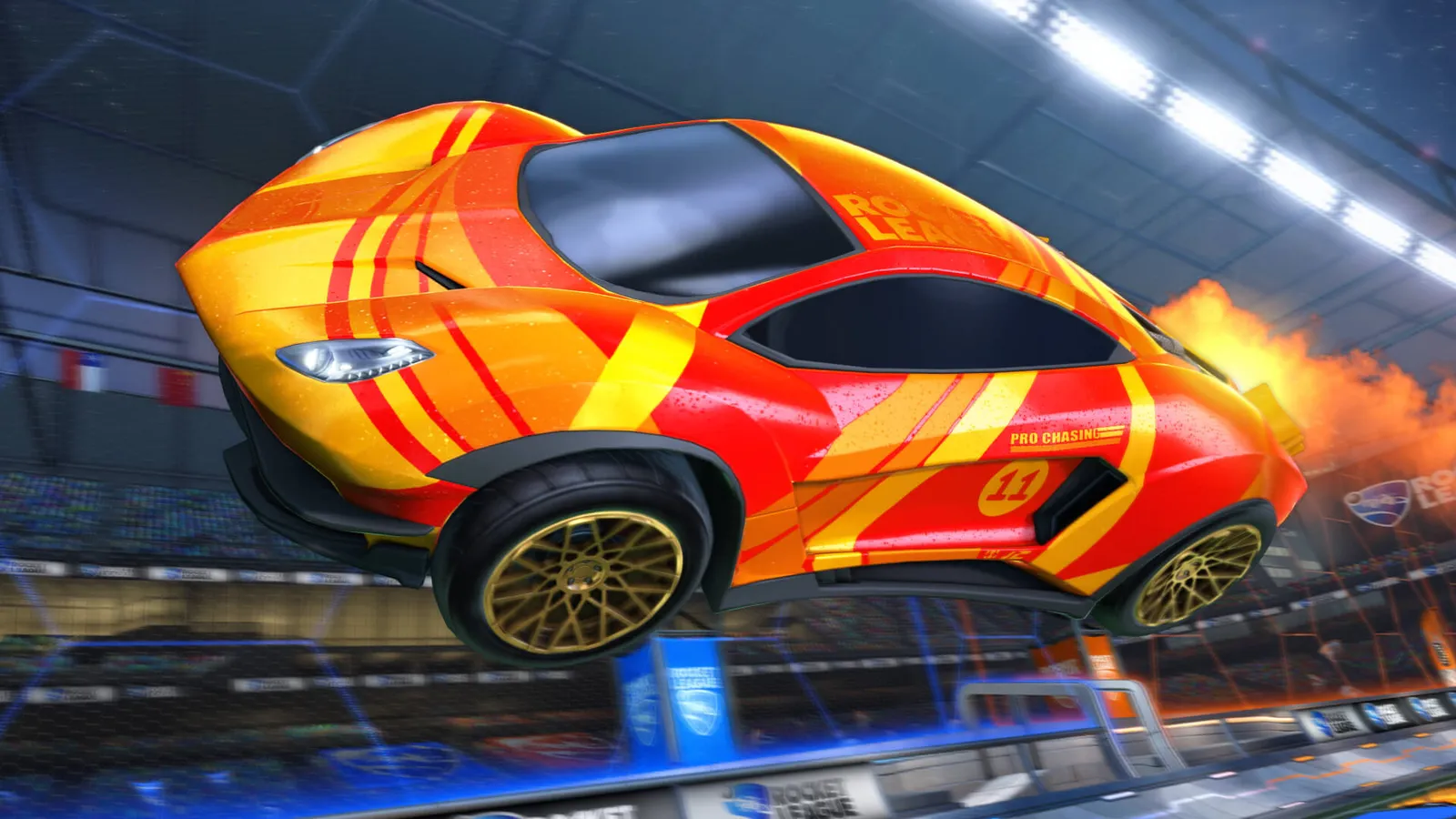
Psyonix's free-to-play car soccer game on Unreal Engine 3, available on PC only through the Epic Games Store since 2020. It is light on the GPU, so at high refresh rates the CPU decides frame rate, and clarity matters more than looks.
What limits performance in Rocket League
Rocket League runs on Unreal Engine 3 (Vehicular soccer, 2015). Official and researched system requirements:
Stable frame rates matter most in fast wall play like this.
- Minimum: Target 1080p, 30 FPS; OS Windows 7 64-bit or newer; CPU 2.5 GHz dual core; RAM 4 GB; GPU NVIDIA GeForce GTX 760 or AMD Radeon R7 270X (2 GB VRAM); Storage 20 GB
- Recommended: Target 1080p, 60 FPS; CPU 3.0 GHz+ quad core; RAM 8 GB; GPU NVIDIA GeForce GTX 1060 or AMD Radeon RX 470 (4 GB VRAM); Storage 20 GB
The settings that cost the most frames
Menu names and sections below are the ones in the game. Start here, test after each change, and keep the ones that give a clear gain.
- Resolution (Settings > Video): native resolution, or lower for more frames. Native resolution gives the clearest ball and car outlines.
- V-Sync (Settings > Video): V-Sync adds input lag; use the FPS cap with G-Sync/FreeSync instead.
- Frames Per Second (Settings > Video): Uncapped. A dropdown with fixed steps and an Uncapped entry at the bottom; matching your refresh rate is the usual advice.
- Anti-Aliasing (Settings > Video): Off. Off gains the most frames; FXAA Low smooths edges at small cost.
- Render Quality (Settings > Video): High Performance. The main quality preset; High Performance gives the steadiest frame times.
- Render Detail (Settings > Video): Performance. Detail level of the arena and cars.
- World Detail (Settings > Video > Advanced): Performance. Matters most on CPUs with four cores or fewer.
- Particle Detail (Settings > Video > Advanced): Low. Fewer particles mean less clutter around the ball.
- Effect Intensity (Settings > Video > Advanced): Low. Tones down goal explosions and boost effects.
- High Quality Shaders (Settings > Video > Advanced): Off. Cosmetic shading with a steady cost.
- Ambient Occlusion (Settings > Video > Advanced): Off. Soft shadowing that adds nothing to gameplay.
- Dynamic Shadows (Settings > Video > Advanced): Off. Adds load to the renderer; the shadow under the ball is still drawn.
Smaller options
| Setting | Where | Recommended |
|---|---|---|
| Display Mode | Settings > Video | Fullscreen |
| Texture Detail | Settings > Video > Advanced | Low on the Low preset up to High on Ultra |
| Depth of Field | Settings > Video > Advanced | Off |
| Bloom | Settings > Video > Advanced | Off |
| Motion Blur | Settings > Video > Advanced | Off |
| Transparent Goalposts | Settings > Video > Advanced | On |
Upscaling and frame generation
No upscaler (DLSS, FSR or XeSS) is listed for this game. No frame generation is listed. No Reflex or Anti-Lag 2 option is listed.
Frame time spikes show up when you boost across a busy pitch.
How to show the FPS counter
- Open Settings and go to the Interface tab.
- Choose "Performance Summary" (or Performance Short/Long) from the Performance Graphs drop-down.
- The graph shows live FPS plus frame, game, render and GPU timings.
More Rocket League tips
Uncap the frame rate
- Open Settings > Video.
- Set the Frames Per Second dropdown to your refresh rate, or to Uncapped (bottom of the list).
- Uncapped works with V-Sync off and can cause tearing without G-Sync/FreeSync.
The old 250 FPS slider was replaced by this dropdown in v1.94 (April 2021), so config edits are no longer needed.
Config file location
- Video options are stored in TASystemSettings.ini in Documents\My Games\Rocket League\TAGame\Config.
- Close the game and back up the file before editing it.
Guides describe the AllowPerFrameSleep=False edit as an old way to lift the cap; the in-game Uncapped option replaces it.
Epic Games only
- Rocket League has been Epic-only on PC since 2020; it is launched from the Epic Games Launcher.
- Upscalers such as DLSS or FSR are not offered in the game; lower Render Quality or the resolution instead.
Quick checks that help in any game
Before you spend an hour in the menus, rule out the common system-level causes of low FPS and stutter in Rocket League:
- Update your graphics driver and restart. Game-ready drivers often include fixes for new releases.
- Set the Windows power plan to Balanced or High performance, and turn on Game Mode.
- Enable the XMP or EXPO memory profile in your BIOS. Many PCs run RAM below its rated speed, which costs frames in CPU-limited games.
- Install the game on an SSD, not a hard drive, to avoid hitching when assets stream in.
- Close browsers, launchers and overlays you do not need. Each one takes CPU time and memory.
- Watch your temperatures. A CPU or GPU that overheats lowers its clocks, and the result is lower, uneven frame rates.
- Match the frame cap to your monitor, or use adaptive sync so a steady frame rate does not tear.
How to test a change properly
Change one setting at a time and repeat the same short test, ideally in the same place or mode, while watching both the average and the lowest frame rates. The 1% lows tell you more about smoothness than the average does. If a setting changes the picture a lot but the frame rate barely moves, put it back; if it moves the frame rate a lot and the picture barely changes, keep it lower. Check whether the GPU or CPU is the one running at 95 to 100 percent: lowering resolution-related settings only helps when the GPU is the bottleneck, while lowering view distance, crowd and physics options is what helps when the CPU is.
Best settings for your hardware
Every PC is different, so the best choice depends on your CPU, graphics card and monitor. On DontLag you can find recommended settings for each hardware tier on the Rocket League settings page.